

By Pod Radar | November 26, 2026
The check is for the catalog. The earnout is for the host who stays in the chair.
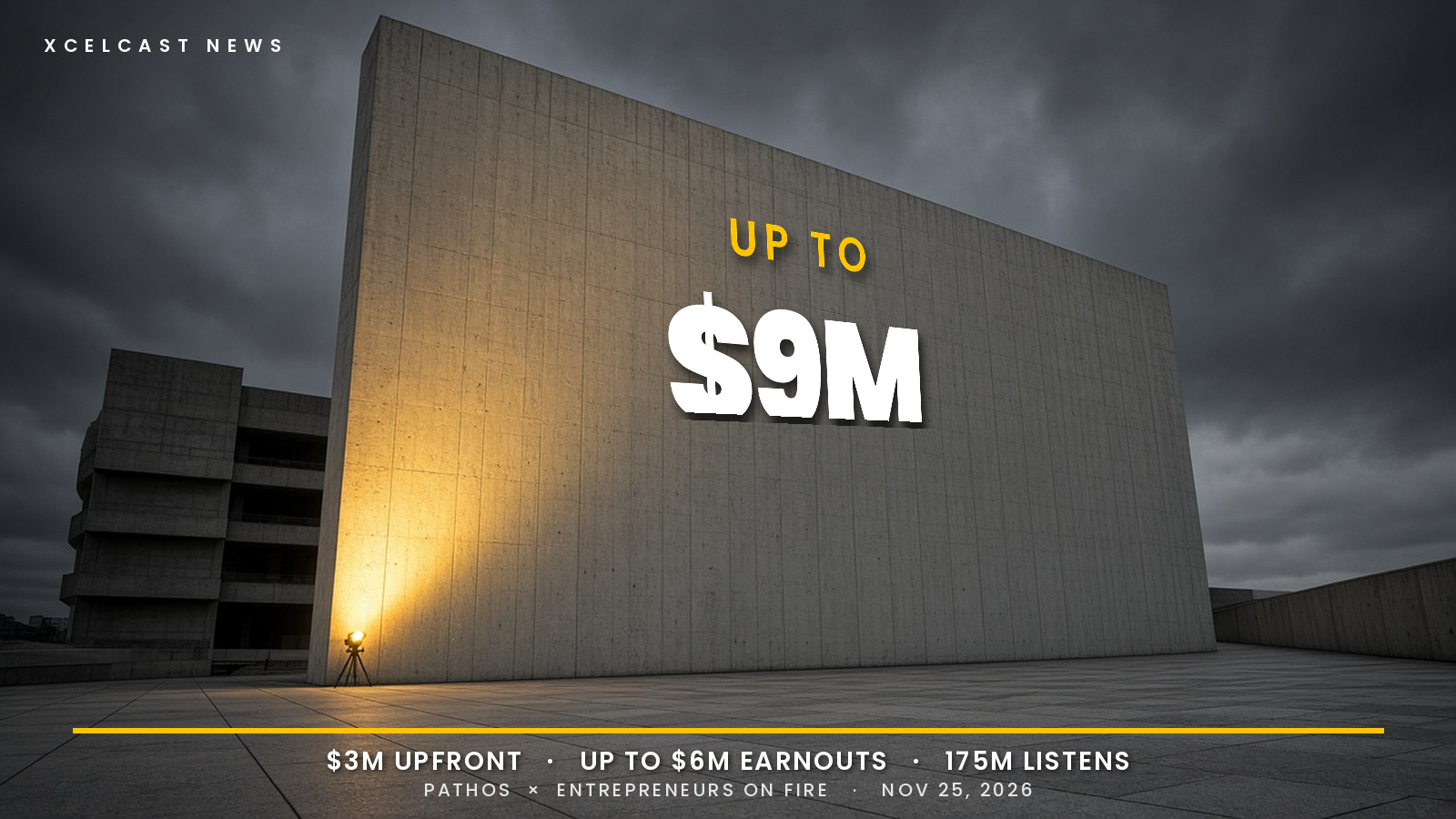
On Nov 25, John Lee Dumas told his audience that Entrepreneurs on Fire "has officially been acquired by Pathos Communications in a deal valued at up to $9 MILLION, with $3 million upfront and an additional $6 million in potential earnouts." Then came the sentence that explains the structure: "I'm not going anywhere!" He remains "the host and leader of Entrepreneurs on Fire," he wrote, and he retains "full editorial control over the podcast."
That is not a founder walking away from a finished library. It is a sale in which most of the headline price only pays out if the person the audience already showed up for keeps showing up.
Question everything that treats a podcast acquisition as the host leaving the building. Buyers are paying for the host-audience bond, and they are writing that bet into the contract.
Pathos bought the company, and signed the host for three years
Pathos Communications plc, a London-listed media company, announced the agreement on Nov 16. It agreed to acquire 100 percent of EOFire, LLC, the owner of the show, for US$3.0 million in cash upfront and up to US$6.0 million in contingent earnouts over three years. Completion was expected on or about Nov 18. Dumas launched the daily interview show in September 2012 from a one-bedroom condo in Portland, Maine; on Nov 25 he put the catalog at 14-plus years, 5,000-plus episodes and 175 million listens.
The regulatory announcement is clear about what Pathos is actually buying. Dumas "has entered into a three-year service agreement" effective from completion, "will remain as host of the podcast, which will remain editorially independent," and "remains highly incentivised" through the earnout. The filing says guests are "typically paying for an appearance," with sponsorship income on top. For the year ended Dec 31, 2025, EOFire generated about US$1.1 million in revenue and about US$0.8 million in net profit, with net assets of about US$0.2 million, all unaudited.
The relationship was already a customer relationship. Pathos and Dumas have worked together since 2023, and since early 2025 Pathos has introduced more than 100 clients to be interviewed on the show. Founder and CEO Omar Hamdi said Pathos had "seen first-hand the quality of the brand and the strength of the network." The buyer knew the chair, then bought the studio, then kept the host in it.
The earnout is the point
Two-thirds of the maximum $9 million is not guaranteed. The base earnout can pay up to US$1.0 million a year for three years, with the maximum annual payment tied to incremental net revenue that reaches US$1.6 million, or the full US$3.0 million if aggregate incremental net revenue across the three periods hits US$6.0 million. A stretch earnout can add a further US$3.0 million at the end of the three years if cumulative net revenue reaches US$15.0 million, scaling from zero at US$9.0 million. Those targets are calculated after incremental third-party costs, and they are conditional on the existing EOFire business achieving US$1.0 million of profit before tax in each earnout period — a step up from the unaudited US$0.8 million in 2025.
In plain language: $3 million is the cash for the company. Up to $6 million is a wager that the show, with Dumas still hosting, keeps growing. Pathos can settle the earnouts in cash, shares, or a mix. That is key-man risk, priced in public.
Two other November deals left the host in the chair
The same month, two more buyers wrote some version of the same sentence.
On Nov 20, PodcastOne announced an agreement to acquire David Meltzer's The Playbook and Office Hours. Together the shows have 30 million downloads, with back catalogs of more than 2,600 episodes and nearly 2,000 episodes. The initial term is two years, with five new episodes of each show a week — 10 a week, about 520 a year, and more than 1,000 over the term. Financial terms were not disclosed, and the release does not spell out what happens to the underlying rights after those two years. What it does spell out is volume, distribution, advertising, and Meltzer's brand. This is not the same transaction as Pathos buying 100 percent of EOFire, LLC. It is still a buyer paying to put a living host's shows on its rails.
A few days earlier, UK-based Raccoon Media Group announced a majority investment in The Rock Fight, the outdoor-industry podcast hosted by Colin True. The company dated the announcement Nov 12 and posted it on Nov 17. Terms were not disclosed. The sentence that matters is the same one: "While Raccoon may be taking a majority stake in the podcast, Colin will retain full editorial control." True stays the voice; Raccoon, in CEO Mike Seaman's words, is "not here to tell Colin what to say." Among the ideas on the table is Rock Fight Live, a tour to outdoor-industry events.
Three deals, three structures, one pattern. A full company sale with a three-year service agreement and a majority of the price in earnouts. A two-year network agreement built on a host's name and a large catalog. A majority stake that leaves editorial control with the host. The asset being underwritten is not only the RSS feed. It is the person who still has to sit down and talk.
The industry backdrop: this is already a real media business
A $3 million cash check, and a $9 million ceiling, only gets written if podcasting is already a business a public company will put on the London market.
U.S. podcast ad revenue hit $2.9 billion in 2025, up 17.6%, and the IAB has said video is "becoming the leading channel for podcast consumption" (IAB/PwC, April 2026). YouTube is the most-used podcast platform for U.S. weekly podcast consumers, at 39%, versus Spotify 20% and Apple Podcasts 11% (Edison Infinite Dial 2026 via Broadcast Dialogue, March 2026). More than 1 billion people a month watch podcast content on YouTube (YouTube Official Blog, February 2025).
The shows that already run on a host's name are the ones this kind of bid will reach first. As of Nov 26, The Diary Of A CEO with Steven Bartlett sits at #10 on Spotify's U.S. Top Podcasts chart, with 22.2 million YouTube subscribers — a different scale, and the same kind of asset: an interview show whose audience showed up for a person.
Lessons for Creators
If you sell, assume the buyer is buying you. Pathos did not just acquire a feed. It signed Dumas to a three-year service agreement, left him as host, and tied up to $6 million of the consideration to performance after closing.
Read the earnout before you celebrate the headline. Two-thirds of the maximum $9 million is contingent, and each period also requires US$1.0 million of profit before tax from the existing business. "Up to" is doing real work.
A customer can become the acquirer. Pathos had already sent more than 100 clients onto the show. The relationship was in the booking calendar before it was in the sale agreement.
"Acquired" is not one kind of deal. Pathos bought 100 percent of EOFire, LLC. PodcastOne announced a two-year agreement for Meltzer's shows and did not disclose terms or post-term rights. Raccoon took a majority stake and left True with editorial control. Compare the contract, not just the press-release verb.
Editorial control is the public promise; the earnout is the private incentive. All three announcements left the host in the chair. Only the Pathos filing shows, in numbers, how much of the price depends on that chair staying occupied.
What We're Watching
Entrepreneurs on Fire — 14-plus years, 5,000-plus episodes and 175 million listens, per Dumas's Nov 25 announcement. The test case for a host-stays sale: a three-year service agreement, full editorial control, and up to $6 million in earnouts sitting on top of $3 million in cash.
The Diary Of A CEO with Steven Bartlett — 22.2 million YouTube subscribers and Spotify U.S. #10 as of Nov 26, 4.5 from 7,110 Apple ratings. The largest entrepreneur-interview show on our radar, and a reminder of how much of that category's value sits with the person asking the questions.
The Playbook and Office Hours — 30 million downloads and a two-year, 10-episodes-a-week deal with PodcastOne, announced Nov 20. A host-brand moving onto a network's distribution and ad rails, with the financial terms still undisclosed.
The Rock Fight — a specialist outdoor-industry show in which the new majority owner, Raccoon Media Group, has already said the host keeps full editorial control. A smaller deal, and a clean statement of the same idea.
Sources: Dumas's listener announcement, including the up-to-$9 million figure, $3 million upfront, $6 million in potential earnouts, 14-plus years, 5,000-plus episodes, 175 million listens, and the "I'm not going anywhere" and "full editorial control" lines, from Entrepreneurs on Fire, Nov 25, 2026. Pathos Communications plc's acquisition terms, the three-year service agreement, editorially independent host role, guest-appearance and sponsorship model, unaudited 2025 financials, the Pathos client relationship since 2023 and more than 100 introductions since early 2025, earnout mechanics, the US$1.0 million profit-before-tax condition, expected completion around Nov 18, and quotes from Omar Hamdi are from Pathos's regulatory announcement dated Nov 16, 2026 (RNS 2383D), as published in full on TradingView and summarized by Yahoo Finance and Proactive Investors, both linked from the official episode page. PodcastOne's agreement for The Playbook and Office Hours, including the 30 million downloads, catalog sizes, two-year term, and 10 weekly episodes, from the Nov 20, 2026 EIN Presswire release. Raccoon Media Group's majority investment in The Rock Fight, editorial-control language, and dated announcement from the company release (dateline Nov 12, 2026; posted Nov 17). The Diary Of A CEO subscriber count is a YouTube-rounded public figure from the Xcelcast snapshot dated Nov 26, 2026; Spotify position is from Spotify's U.S. Top Podcasts chart, Nov 26, 2026; Apple ratings are from Apple Podcasts show pages on Nov 26, 2026. Edison weekly-platform figures from Infinite Dial 2026 via Broadcast Dialogue, March 2026. YouTube's 1 billion monthly podcast viewers from the YouTube Official Blog, February 2025. U.S. podcast ad revenue from IAB/PwC, April 2026. We analyze shows based on growth, sentiment and velocity of audience. Quotes are from official announcements and primary company releases.