
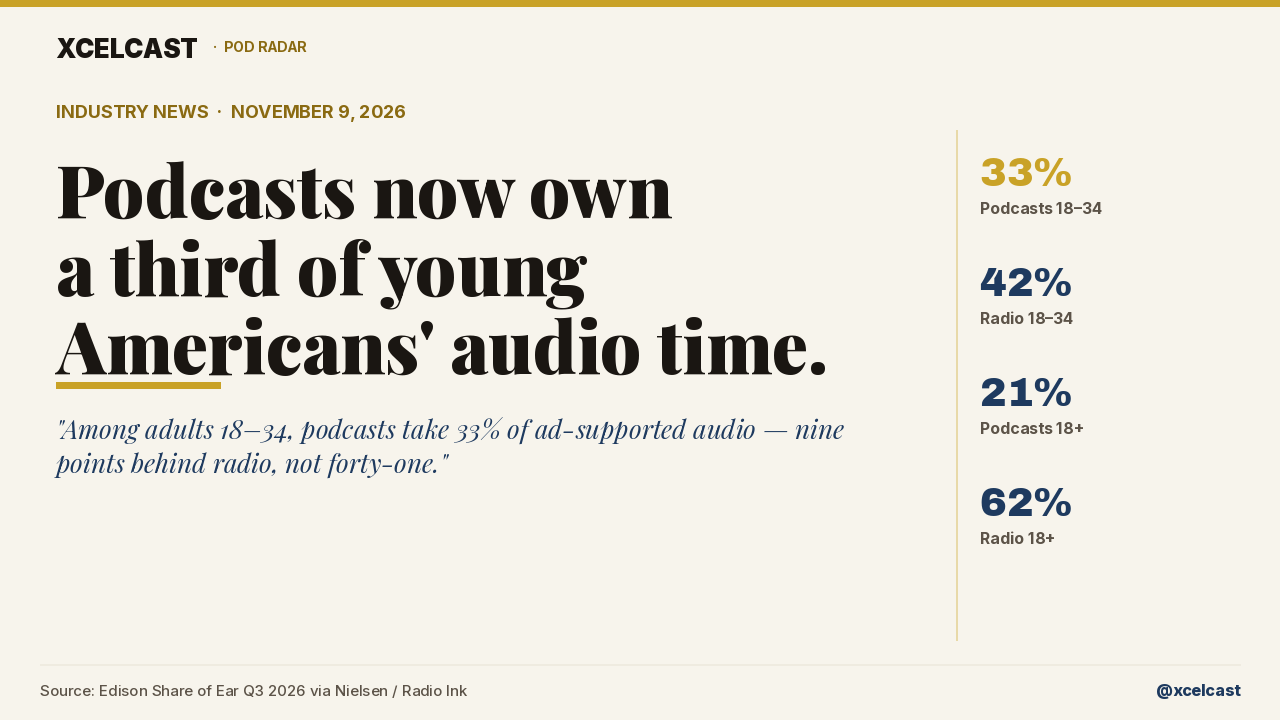
Nielsen and Edison's Q3 Share of Ear puts podcasts at 33% among adults 18–34, nine points behind radio. For all adults 18+, radio still leads 62% to 21%. The decade-long climb is real — and the buying brief has to catch up.
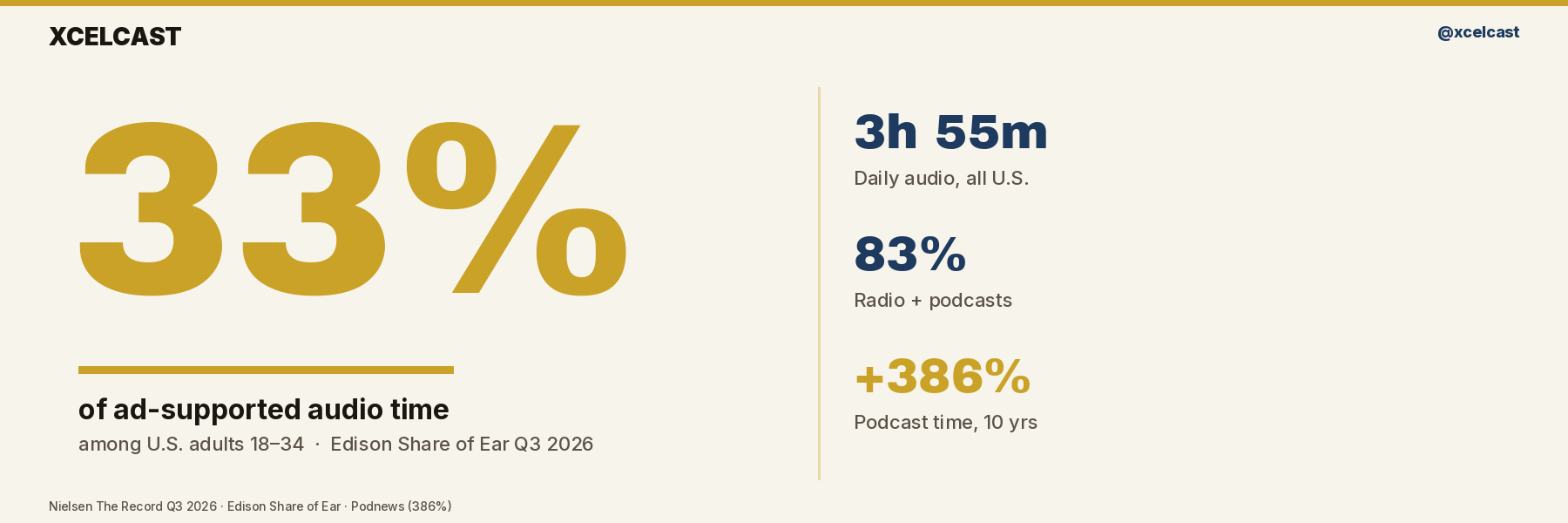
The numbers that dropped Monday morning are the clearest age split the audio industry has published this year. In Nielsen's The Record: Q3 2026 U.S. audio listening trends, built with Edison Research's Share of Ear, Americans spend 3 hours and 55 minutes a day with audio. Of the ad-supported slice of that day, radio and podcasts together take 83%, while ad-supported streaming music services take 15%.
Zoom into age and the story flips from "radio still dominates" to "the next audience is already elsewhere."
Among adults 18 and older, radio holds 62% of ad-supported audio time, podcasts 21%, streaming 15% and satellite 2%. Among adults 18–34, radio is still first at 42%, but podcasts are right behind at 33%, with streaming at 24% and satellite at 1% (Radio Ink, Nov 9, citing Edison Share of Ear Q3 2026). That is a nine-point radio-to-podcast gap for under-35s, not the forty-one-point gap that still defines the total adult market.
Podnews, summarizing the same release, adds Edison's longer arc: total U.S. podcast consumption time is up 386% in ten years (Podnews, Nov 9). Question everything you were told about podcasts being a niche that "can't touch radio." For the demo every brand still wants, they already do.
What the chart actually says
The headline is not that radio is dead. Monthly, radio still reaches 92% of U.S. adults — more than 242 million people — ahead of TV-connected devices (90%), smartphones (87%) and live plus time-shifted TV (85%). It reaches 87% of adults 18–34. About 65% of adult radio listening happens away from home, rising to 73% in weekday drive times, and in the car AM/FM still takes more than 80% of ad-supported audio (Nielsen).
The chart is about time share inside the ad-supported day, not reach. Radio still wins the room. Podcasts are winning a third of the clock for people under 35.
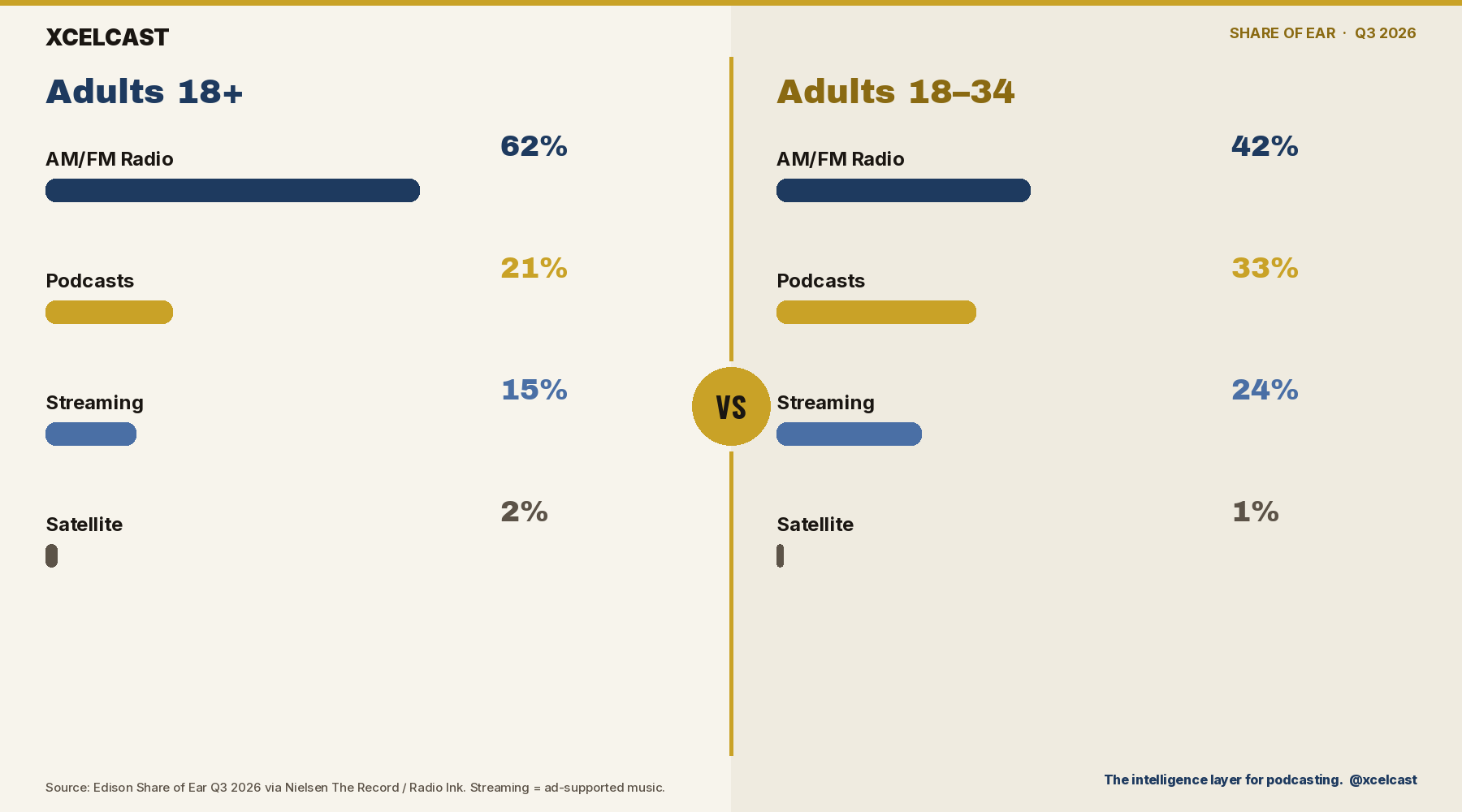
That distinction matters for planners. A campaign that buys only radio still covers almost everyone. A campaign that skips podcasts among 18–34s is leaving a third of their daily ad-supported audio minutes on the table — minutes that used to be almost entirely terrestrial.
The car is not a radio-only story
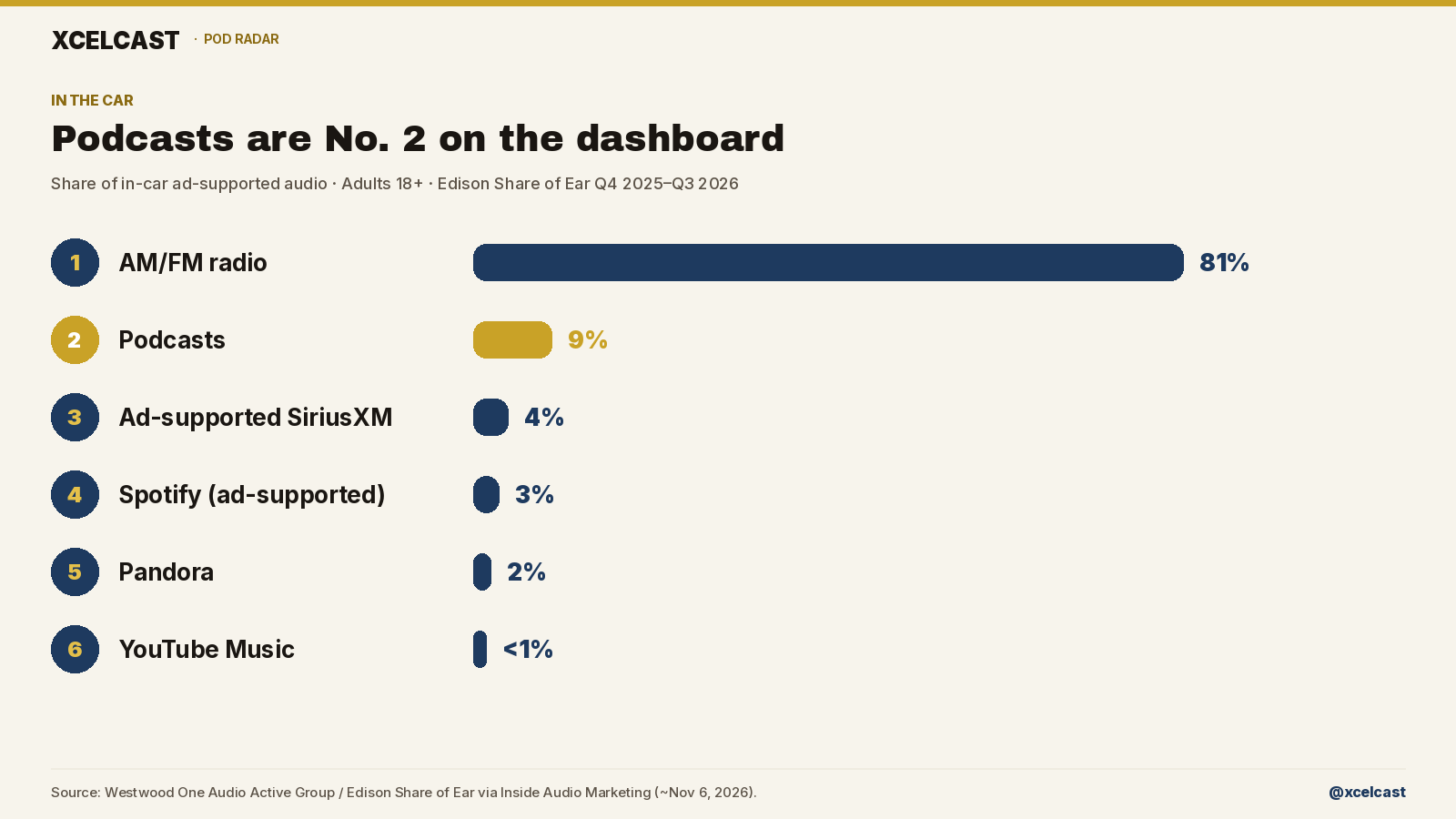
Even inside the dashboard, the podcast wedge is measurable. A Westwood One Audio Active Group read of Edison Share of Ear covering Q4 2025 through Q3 2026 finds podcasts are the No. 2 source of in-car ad-supported audio among adults 18+, at 9%, behind AM/FM at 81% and ahead of ad-supported SiriusXM (4%), Spotify (3%), Pandora (2%) and YouTube Music (under 1%) (Inside Audio Marketing, ~Nov 6). Podcast listening on Spotify still counts as podcast time in that framework, not as music streaming — which is why the podcast line can beat the music apps even while Spotify itself is huge.
Commuting has largely come back: 87% of pre-COVID commuters now work outside the home, averaging 4.7 workplace days a week (Quantilope via the same Westwood One analysis). The drive is still audio's best inventory. It is just no longer a one-format drive.
Where young listeners actually go
Platform share reinforces the age story. In Edison Podcast Metrics for Q3 2026, YouTube is the platform U.S. weekly podcast consumers use most, with Spotify second at 17%, Apple Podcasts third at 9%, and Netflix seventh at 3% (Radio Online, Oct 7). Sounds Profitable's Podcast Landscape 2026 found 63% of U.S. podcast consumers used YouTube for podcasts in the past 12 months, versus 33% for Spotify, 21% for Netflix and 15% for Apple (Sounds Profitable, Oct 1).
That is the distribution map for the same young adults who now give podcasts a third of their ad-supported audio day: video-first platforms, then audio apps, with Netflix already inside the mix.
On Xcelcast's own radar, the shows compounding with that audience are not a mystery. Over the Nov 6–9 window alone, Latent Space added 26,000 YouTube subscribers (434K → 460K) and sits at a 22.1% 30-day growth. Armchair Expert jumped 376K → 418K (+42K). The Ezra Klein Show climbed 41 → 32 on Spotify's U.S. Top Podcasts chart. The Diary Of A CEO added 200K subscribers to 21.8M. Those moves sit on listener ratings, review sentiment, recent growth and channel size — the same inputs we publish against — and they line up with a demo that is spending a third of its ad-supported audio day on podcasts.
The money still lags the minutes
U.S. podcast ad revenue hit $2.9B in 2025, up 17.6% (IAB/PwC). EMARKETER forecasts $3.76B in 2027, up 10.4% (Business Insider, Nov 4). October's podcast ad-spend leaderboard still had Quince at $6.7M across 1,404 shows (93% host-read), with Mint Mobile, Shopify and BetterHelp right behind, while TV-native buyers such as Carvana (+146%), Boost Mobile (+133%) and Hulu (+128%) were the fastest risers (Inside Radio, Nov 4).
The friction is measurement. Oxford Road's What Brands Want work found 57% of brands name measurement gaps as a top obstacle — 90%+ among brands with $100M+ budgets — and puts as much as $1.15B a year in video-podcast spend on the table if measurement catches up (Inside Radio). Nielsen's own Q3 note is blunt: an audio campaign built without both radio and podcasts "misses the vast majority of the daily ad-supported audio audience." For 18–34s, that sentence should now read as a warning, not a platitude.
Lessons for Creators
- Sell the 18–34 day, not the total-adult average. Radio's 62% adult share is real. So is podcasts' 33% under 35. If your show skews young, pitch the age split, not the blended chart.
- Stay on YouTube and Spotify before you chase the seventh platform. Weekly consumers already put YouTube first and Spotify at 17%. That is where the third of young audio time is forming.
- Treat the car as inventory you can win. Podcasts are already No. 2 in-car at 9% of ad-supported time. Short-form, commute-length episodes and consistent release times still matter.
- Keep host-reads when TV buyers show up. Quince's October lead was 93% host-read. The new auto and streaming dollars are testing rooms that sound trusted, not just rooms that look like TV.
- Publish the proof behind the demo claim. Apple ratings, recent growth and channel size are what buyers ask for when the Nielsen slide hits the deck. Have them ready.
- Do not wait for measurement perfection. Brands already admit the gap. Creators who can show completion, age skew and repeat listening will take the first checks while the currency catches up.
What We're Watching
- Latent Space — 460K YouTube subscribers after +26K in three days, 22.1% 30-day growth. The clearest under-500K compounder on our board right now.
- Armchair Expert with Dax Shepard — 418K subscribers after +42K since Nov 6; still a fixture in Spotify's U.S. Top 20. A mass-young-adult habit show, not a niche feed.
- The Ezra Klein Show — Spotify U.S. chart 41 → 32 in the same window, with a midterm post-mortem episode driving the climb. Politics audio is where young attention showed up this week.
- Hard Fork — 76.4K subscribers, 21.8% 30-day growth. Small channel, high engagement, squarely in the tech lane young listeners over-index on.
- The Diary Of A CEO with Steven Bartlett — 21.8M YouTube subscribers after +200K since Nov 6. Proof that the biggest video-podcast rooms keep compounding while Share of Ear shifts under them.
Sources & notes: Nielsen The Record: Q3 2026 (Nov 2026); age-break Share of Ear figures as reported by Radio Ink (Nov 9, 2026); Podnews (Nov 9) for the 386% decade figure; in-car shares from Westwood One / Inside Audio Marketing; platform shares from Radio Online on Edison Q3 2026 and Sounds Profitable Podcast Landscape 2026; ad spend from IAB/PwC, EMARKETER via Business Insider, and Inside Radio as linked. Xcelcast radar figures compare Nov 6 and Nov 9, 2026 snapshots and the Nov 9 Spotify U.S. Top Podcasts chart. Subscriber counts are YouTube-rounded and are not total audience. Podnews quoted radio at ~61% for adults; Radio Ink's 62/21/15/2 breakdown is used here because it sums to 100% and matches the detailed Edison cut.