The Fracture of the Right
The Great 2026 Podcasting Pivot: Populism Surges as the 'Old Guard' Stagnates** The independent media landscape in Q1 2026 isn't just evolving; it’s undergoing a profound geopolitical and ideological realignment. Based on the latest Xcelcast data, the dominance of traditional conservative and pro-interventionist voices is being directly challenged by a powerful wave of populist, isolationist, and culture-first creators.
We are witnessing a "Momentum Gap" that tells us more about the American psyche than any poll. The audiences are voting with their subscribe buttons, and they are voting against the establishment.
📉 The Churn: When Consistency Becomes Stagnation
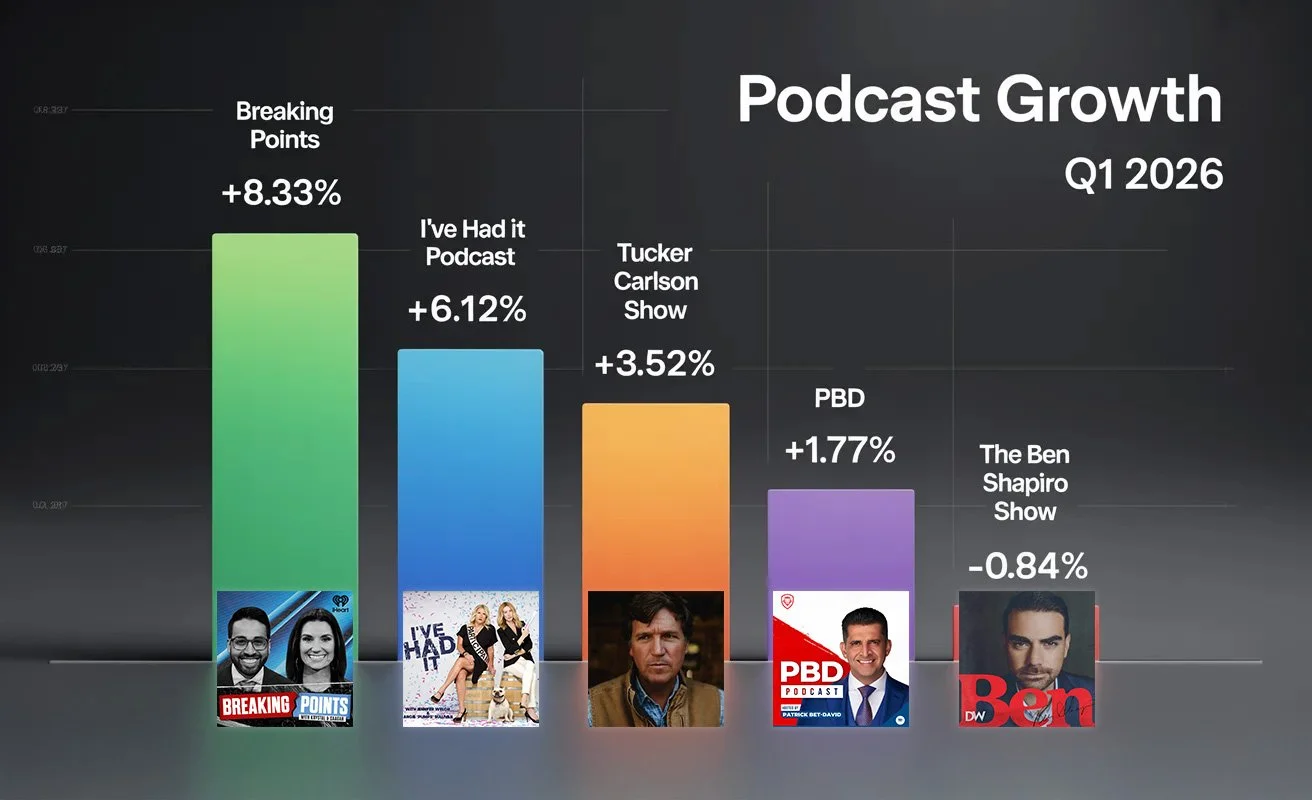
The most surprising figure from the Q1 data is the stagnation and slight decline of Ben Shapiro (-0.84% growth, -60,000 net subscribers). For years, Shapiro and The Daily Wire cohort were the engines of right-wing growth. So, what happened?
Shapiro’s consistent, unwavering support for interventionist foreign policy, particularly concerning Israel, has met a powerful new resistance: America First isolationism. In 2026, many younger and populist viewers perceive his stance as "establishment neoconservatism." As he spends time "purging" dissenting voices, his growth has cooled, while his core audience seems to have reached its saturation point, forcing the channel into its first era of active churn.
Similarly, Patrick Bet-David (PBD Podcast), while still growing (+1.77%), is seeing a significant deceleration. His audience of budding entrepreneurs seems currently less concerned with pragmatic business advice or polished political analysis and is being drawn away by more "raw" dissent.
🚀 The Explosion: Isolationism, Dissent, and 'Fed-Up' Culture
The channels currently capturing the attention economy are those that have leaned fully into the widening gap between the "American People" and the "Military Industrial Complex."
The Independence Premium: Tucker Carlson & Candace Owens Since exiting legacy structures (Fox News and The Daily Wire respectively), Tucker Carlson (+3.52%) and Candace Owens (+2.97%) have redefined themselves as leading skeptics of U.S. foreign aid. Their growth is driven by a "forbidden truth" narrative, appealing to viewers who feel alienated by mainstream conservative media. They provide "unfiltered" dissent that a traditional corporate framework cannot sustain.
The Bottom-Up Revolt: Breaking PointsBreaking Points is the undisputed winner of the quarter (+8.33% growth). Krystal Ball and Saagar Enjeti represent the "Left-Right Populist Alliance." Their rapid expansion confirms that the sentiment shift isn't purely "Left vs. Right." Their audience is composed of the disaffected from both sides—unified by a shared belief that domestic pain (inflation, borders, cost of living) is being exacerbated by reckless foreign spending.
The Pivot to 'Vibe': I've Had It Podcast Finally, the +6.12% growth of the I've Had It Podcast highlights a profound secondary trend: Geopolitical Fatigue. * Viewers are tired of ideological lecturing and a 2.5-year cycle of catastrophic news. The audience is shifting toward culture-first, "common sense" skepticism. They are moving away from deep-dives into policy and toward creators who simply reflect that they are "over it."
📊 Performance at a Glance: Q1 2026
The numbers speak for themselves. The "New Right" (Tucker/Owens) and the "New Populism" (Breaking Points) are the engines of current growth, while the established ideological titans are facing a difficult reality check.
Creator Audience Q1 Growth
Breaking Points
Populist / Anti-Intervention +8.33%
I've Had It Podcast
Culture / Fatigue-based +6.12%
Tucker Carlson
Isolationist / Dissident Right +3.52%
PBD Podcast
Business / Moderate Politics +1.77%
Ben Shapiro
Pro-Intervention / Establishment -0.84%
💡 The Takeaway: A Divergent Digital Future
The Xcelcast data from Q1 2026 is clear: Audience loyalty is shifting from institutions to individuals, and from ideology to populism. The creators who challenge the status quo, even if controversially, are experiencing a compounding momentum. Those who attempt to hold the traditional line are seeing their audiences fracture. The 2026 Attention Economy isn't about having the largest audience anymore; it’s about having the most energized, disaffected, and engaged one.